Buffalograss Research Updates
Buffalograss Germplasm Maintenance & Evaluation
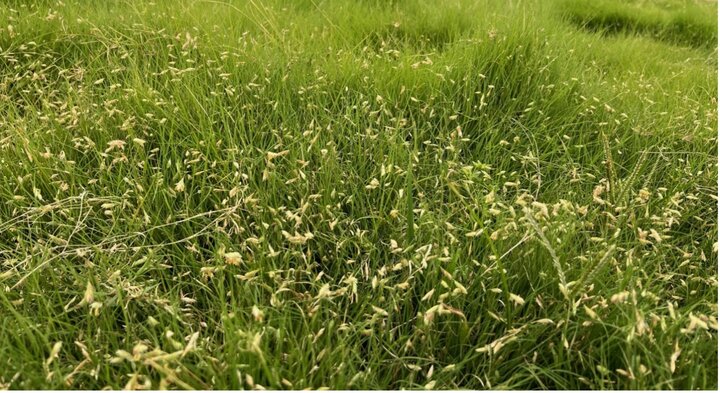
Germplasm and its maintenance is an important aspect of any successful breeding program. Germplasm serves as a reservoir of genetics and traits that can be introduced into future breeding lines, leading to cultivars with superior performance.
Our program emphasizes collecting native buffalograsses growing in undisturbed sites throughout the region. Individual lines are evaluated over multiple seasons to determine if they have attributes that could be incorporated into future buffalograss cultivars. Key evaluation criteria include canopy density, gender expression, color and late season color retention, uniformity, competition with tall fescue, and overall visual turf quality.
Lines of interest are often grouped with similar lines in crossing blocks to try and fix those desired traits into future breeding populations, simplifying downstream trait introgression. Crosses are then made into elite backgrounds to introduce those desirable traits into breeding lines, that are then advanced through our plant breeding pipeline.
Seeded Buffalograss Selections
Buffalograss is dioecious, having separate male and female plants, which comlpicates breeding since research is needed to develop male and female lines separately that when combined produce superior progeny or seeded populations. Buffalograss breeding is further complicated since there is a need to develp both seeded and vegetative lines separately. While both seeded and vegetative types require fast establishment, pest resistance, stand persistence, and good turf quality, there are notable differences in the breeding strategies and outcomes for each type. At a high level, seeded buffalograss requires parental female lines that are high yielding along with males that provide the pollen to support seed production. Vegetative lines are often clonally propagated female lines and there is a preference for minimal flower production and an absence of males.
Objective
This project was designed to identify high yielding buffalograss populations with exceptional turf quality.

Study
Advanced buffalograss breeding populations (n=14) derived from parents selected for chinch bug resistance, shade tolerance, establishment rate, turf quality, and yield were grown in isolated 10’ x 10’ plots. Seed from each plot was harvested each year over multiple years.
Progress
Biomass and seed yield were collected and compared. On figure 1, individuals not producing at least 300 g seed per 100 sq ft plot (filled circle) were not continued.
The remaining lines (plus symbol) were harvested again in the next season (triangles). Data from one of the advanced lines was not collected, but there was an increase in biomass and seed yield in most of the selected lines.
Elite Buffalograss Breeding Lines Evaluation
Data collection began on elite seeded buffalograss breeding populations that were developed to become the next generation of seeded buffalograss cultivars.
Objective
Compare elite seeded material to industry standard lines and collect data that uniquely characterizes each line.

Study
Seven experimental breeding populations were grown alongside five industry standard lines. The 12 lines were arranged in a randomized complete block design with four blocks.
Progress
The following rating criteria were used to characterize each line in the study.
| Growth Habit | Establishment Rate |
| Internode Length | Plant Vigor |
| Internode Diameter | Texture |
| Lateral Spread | Leaf Length |
| Gender | Leaf Width |
| Plant Height | Leaf Color |
| Inflorescence Height | Leaf Pubescence |
| Inflorescence Color | Fall Color Retention |
| Winter Hardiness and Survival | |
The first year of data collection completed in 2025 and it will be repeated in 2026. From this research we are able to distinguish the 12 experimental lines from eachother. There are plans for regional trials of these lines to be initiated in 2026.
Low Input Demonstration Established
It is often recommended to manage buffalograss with at least 1” of water per month and 2 lbs N/1,000 sq ft during the growing season. These minimal recommendations are designed to maintain turf cover with minimal resources; it is important to note that increases in water and N rates can enhance visual quality. Many buffalograss managers adopt buffalograss as a “no maintenance” species, and do not provide any supplemental irrigation or fertility.
Objective
Evaluate established plots of buffalograss, fineleaf fescue, perennial ryegrass, Kentucky bluegrass, and tall fescue over multiple years with no or minimal inputs.
Study
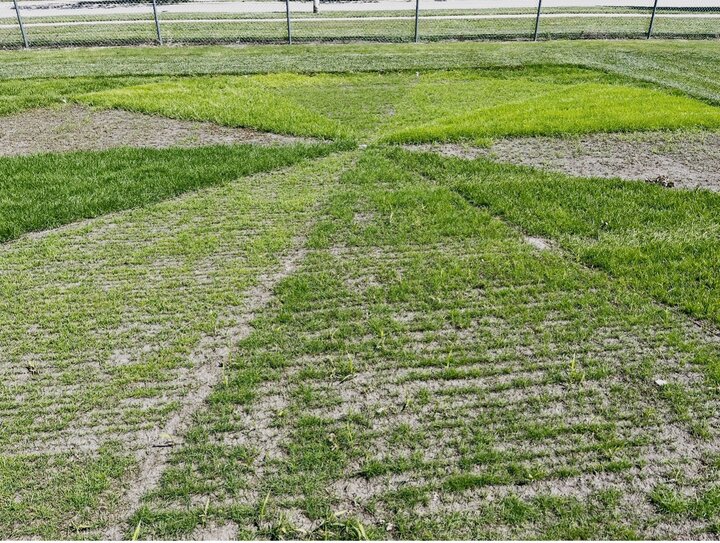
Two spoke and wheel plots were established and planted to new and old cultivars of buffalograss, fineleaf fescue, perennial ryegrass, Kentucky bluegrass, and tall fescue. Plots were established in 2025. One plot will be managed with no inputs and the other will be managed with buffalograss recommended inputs of 1” water per month and 2 lbs N/1,000 sq ft during the growing season.
Cultivar list
Blue Hornet (Sheeps fescue), Cardinal II (Creeping red fescue), Nui and Apple 3GL (Perennial ryegrass), Blue Bonnet and Blue Note (Kentucky bluegrass), K-31 and Spyder (Tall fescue), and Cody and Sundancer (Buffalograss).
Progress
Plots were established and preliminary establishment data was collected.
Winter Dormancy Timing in Elite Vegetative Buffalograss Lines

Buffalograss is a warm-season species that enters winter dormancy in the fall following a hard frost and breaks dormancy in the spring as soil temperatures begin to warm, typically when soil temperatures approach 50 degrees F. A goal for vegetative buffalograss line development is to extend the growing season by identifying lines that enter dormancy later in the fall or break dormancy earlier in the spring. Care must be taken to avoid also selecting for lines that have compromised winter dormancy as that would make them susceptible to winter injury.
Objective
Develop a model to predict timing of winter dormancy and use the model to identify lines that greenup earlier in the spring.
Study
Collect 3” soil temperature data from an established buffalograss stand every two weeks during spring greenup. While collecting soil temperatures, also collect digital images that can be processed to quantify greenness levels.
Progress
First year data was collected and plotted. A preliminary model was developed showing a nearly 5% increase in greenness per increased degree C after April 28th.
More data is needed to refine and validate the model but we anticipate that it will provide a means for selecting lines that greenup faster in the spring or maintain their green color later into the fall.
National Turfgrass Evaluation Program Updates
NTEP Tall Fescue
Our program is managing the 2024 National Tall Fescue Test for the National Turfgrass Evaluation Program (NTEP). Tall fescue is one of the most important lawn species managed throughout the region. The trial receives reduced irrigation and there are more observable differences between the varieties in the trial than in previous years when it has been managed under optimal conditions.
Objective
Evaluate new and experimental tall fescue lines relative to industry standard entries under reduced irrigation inputs in the central Great Plains region.
Study design
The study is arranged as a randomized complete block design with three replications and maintained at a three-inch mowing height. The study includes 108 tall fescue lines, including six standard entries.
Progress
Data was collected for genetic color, spring greenup, spring and fall density, fall color, leaf texture, and monthly quality from April through October. Significant differences were observed among all evaluated traits except for spring greenup, spring density, and April quality.
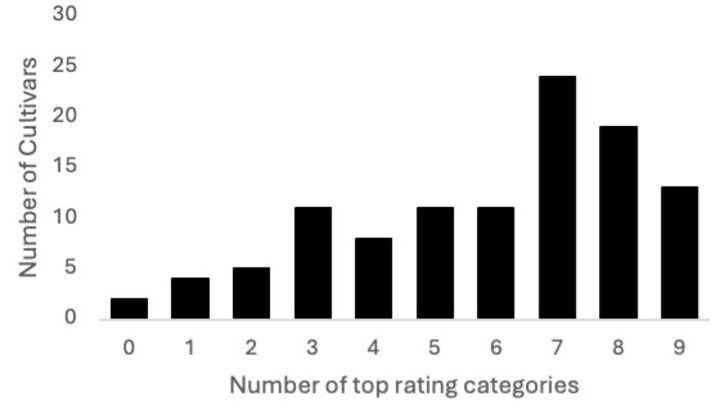
Thirteen lines were among the top performers in 9 out of the 10 rating categories. Interestingly all but one was an experimental line, suggesting the next generation of tall fescues are expected to outperform the current cultivars evaluated in this trial.
NTEP Kentucky Bluegrass
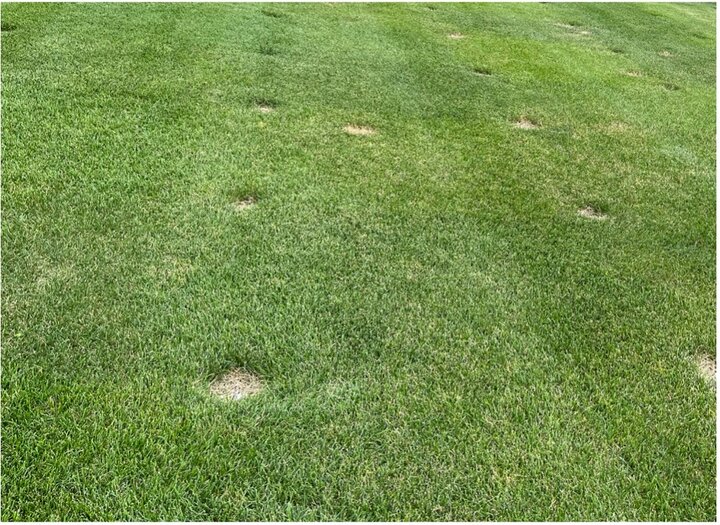
The National Turfgrass Evaluation Program (NTEP) coordinates several species and variety trials throughout the country. We are a test site for the multi-year 2023 National Kentucky Bluegrass test.
Kentucky bluegrass is an important turf species used throughout the region in lawns and athletic fields.
Objective
Evaluate new and experimental Kentucky bluegrass lines for performance in the central Great Plains region.
Study
The study was established in September 2023 and arranged as a replicated complete block design with three replications. There are 56 entries maintained at a 2.5 inch mowing height under evaluation.
Progress
Each Kentucky bluegrass plot was evaluated for genetic color, spring green-up, leaf texture, visual quality per month of the growing season, fall canopy density, and establishment rate. This year marked the first full year of the study and data has been submitted to NTEP. Once processed, data will be made publicly available through the NTEP website. Keep in mind that data is available for several sites, so if there is a trait you are interested in that was not evaluated in Nebraska, be sure to explore some of the other state reports.
NTEP Perennial Ryegrass
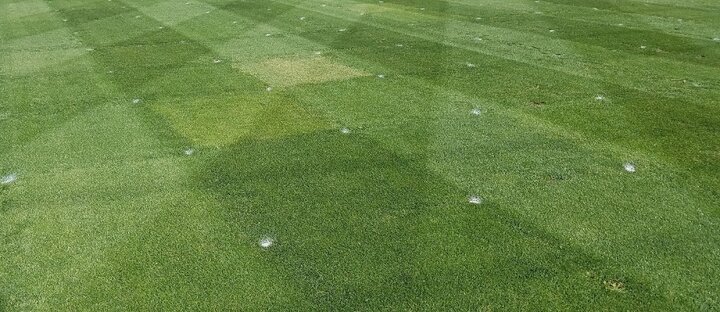
The National Turfgrass Evaluation Program (NTEP) coordinates several species and variety trials throughout the country. We are a test site for the multi-year 2022 National Perennial Ryegrass test. Perennial ryegrass is an important turf species used throughout the region in lawns and athletic fields and is highly regarded for its rapid germination.
Objective
Evaluate new and experimental perennial ryegrass lines for performance in the central Great Plains region.
Study
The study was arranged as a randomized complete block design with three replications. It was established in September 2022 and maintained at a two-inch mowing height. There are 83 entries, including five standard entries.
Progress
Each perennial ryegrass plot was evaluated for genetic color, spring green-up, visual quality per month of the growing season, and establishment rate. Early data for this study is available through the NTEP website. Keep in mind that data is available for several sites, so if there is a trait you are interested in that was not evaluated in Nebraska, be sure to explore some of the other state reports.
Greens Studies
Tine Cultivation and Sand Incorporation Study

Objective
Evaluate pre- and post- tine cultivation sand incorporation as impacted by tine type.
Study
The study was arranged as a split plot randomized complete block design with three replications. Each plot measured 14 ft by 4 ft. Treatments were applied using a Toro Procore 648 with a 48” swath.
Main Plots (42’ X 60’ with a 6’ border between)
Topdress before tines with 0.25” on surface (equates to 1 ton/1000 ft2 or 20 ft3/1000ft2)
Topdress after tines
Sub-plots (tine treatments) set at 3-3.5” depth
5/8’ X 6" Viper Nose™ Quad 3/4" Mount (2600 RPM 2 ring on top setting 648)
1/2" X 6”Viper Nose™ Quad 3/4" Mount (2600 RPM 2 ring on top setting 648)
3/8 inch tine (4 ring on top setting 648)
Talon Tine 1/2" x 6", 3/4" Mount (2 ring on top setting 648)
108-9198 TITAN SOLID ROUND 4.50" .25" OD (5 ring on top setting 648)
108-9202 TITAN SOLID ROUND 4.50" .50" OD (5 ring on top setting 648)
108-9170 SIDE EJECT MAX 4.75” .28" ID (5 ring on top setting 648)
108-9221 TITAN CROSS 4.50" – .50"OD (5 ring on top setting 648)
108-9239 TITAN SOLID SLICING 4.50" .75" OD (5 ring on top setting 648)
108-9161 SIDE EJECT 4.75" .53" ID .66" OD (5 ring on top setting 648)
114-0551 TITAN HOLLOW EXT. TAPER 5.75" .53"ID .66" OD (2 ring on top setting 648)
DryJect 3X3
Untined Control
DryJect 2X3
Data Collection
24-48 hrs after treatment sample for OM with ¾” sampler; sample 0-1”, 1-2”, 3-4”, 4-5” sampled monthly.
24-48 hrs infiltration with single ring infiltrometer, sampled monthly.
TDR weekly after nighttime irrigation; 2 depths.
Quality 1-9 weekly; 1=Unacceptable, 6= acceptable.
Cultivation recovery visual estimate weekly. Scale 1-9 as a percentage recovery.
Digital image of “pie” slice sampler to include aeration hole; weekly for 3-6 weeks. Take a sample near edge of plot.
GS3 or green speed weekly starting 3-4 days post treatment.
Wetting Agents Study
Objective
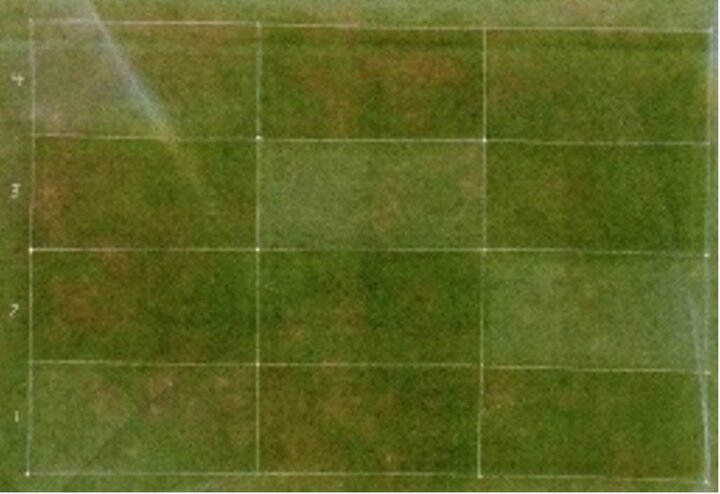
Evaluate wetting agent longevity with dry-down periods promoting localized dry spot.
Study
The study was arranged as a randomized complete block design with four replications. Each plot was 5 ft x 10 ft. Treatments (water control or two wetting agents) were applied monthly from August through November. After treatment, plots were dried to wilting, evaluated, and then rewetted before starting the dry down again for two dry down cycles between each application.
Data Collection
Volumetric water content at multiple depths, visual quality, visual estimation of recovery, green speed, and surface firmness were measured 3-5 days post each dry down event.
Seeding and Weed Management Studies
Consumer Seeding Evaluation
Objective
Determine establishment and quality of a random sample of cool season turfgrass mixtures available to consumers.
Determine if the use of mesotrione at seeding influences establishment and quality.
Study
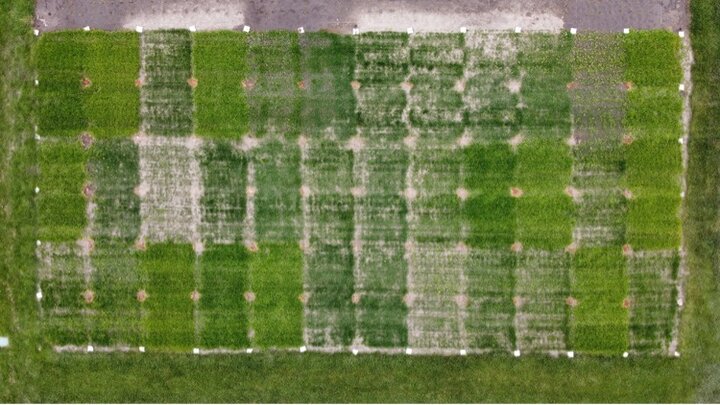
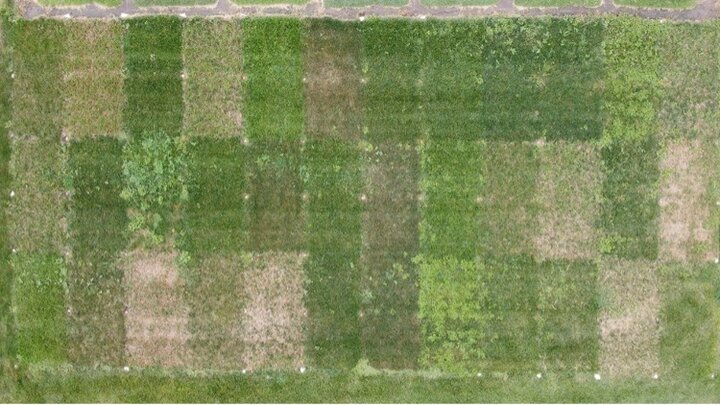
The study was arranged as a randomized split block design with 3 replications. There were 12 entries and 2 mesotrione treatment (with or without). Each plot measured 5 ft by 5 ft.
Progress
The study is complete, but the plots are maintained to see the long-term benefit of the early mesotrione application. See images and progression of turf performance below.

Herbicide Selection Results for Foxtail Before or After Emergence in Turfgrass Areas
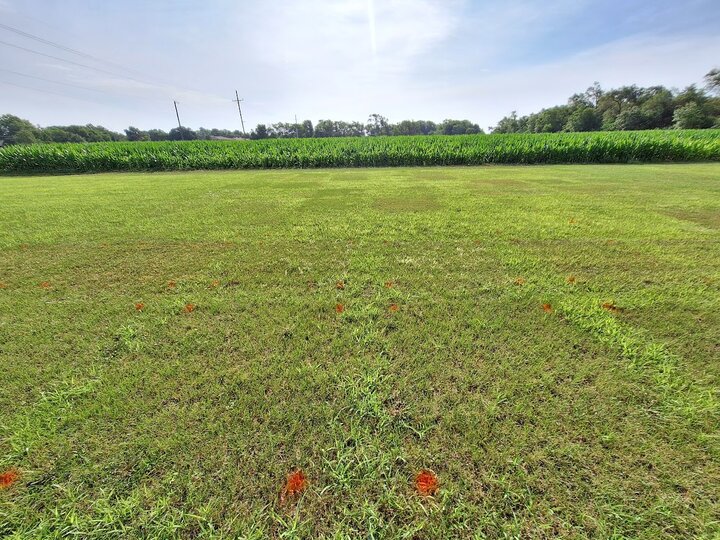
This study was conducted at the University of Nebraska’s East Campus Turf Research Center at Lincoln, NE, on a 7-year-old stand of Kentucky bluegrass mismanaged with low fertility and low mowing to encourage yellow foxtail growth. Populations of foxtail ranged from 12-40% over the course of the trial in untreated plots. The stand was mowed at 2 inches and irrigated to prevent drought stress. Plots were 5' x 5' and sprayed with a CO2 backpack sprayer using a 3-nozzle boom with 8002 vs nozzles at 30 psi. Treatments were initiated on May 5th with separate timings with or without a sequential application starting on June 27th at 3-5 leaf foxtail and or July 15th at 3 tiller foxtail. At no time during evaluations did any of these products result in damage to the Kentucky bluegrass stand.
Athletic Field Applied Research
Bermudagrass Traffic Adaptation in Lincoln, Nebraska

Objective
Evaluate three different hybrid cold-tolerant bermudagrass cultivars with different overseeding applications and rates following traffic simulation.
Experiment Design

The study area is 50 ft x 108 ft and established to randomized strips of Tahoma 31, Latitude 36, and IronCutter bermudagrass. The area was managed using standard bermudagrass management with nitrogen fertilizer (0.5 to 1 lb per 1,000 sq ft) applied from July to September and irrigation applied as needed to prevent wilt. The area was mowed at 0.75 in two times per week. Traffic is applied perpendicular to the bermudagrass strips and simulated by a modified Toro ProCore 648 (right) with feet constructed of 9 total 0.5 in spikes per section (total of 6 sections). The spikes are like those used for the Husker Football student-athletes. Each traffic pass equals one traffic day of football. Plots were then seeded at different rates of 0, 2, 5, or 10 lbs per 1000 sq ft. with HGT Kentucky bluegrass (KBG), SunRye perennial ryegrass (PRG), or no overseeding. Each seeding was split by seeding method (slit seeder (SS) or drop spreader (DS)). Seeding was initiated for some plots in July, and others were delayed until August. Overseeding continued through mid-October. Data collected from August to mid-November.
Progress
Year 1 (2024) Available Here
Year 2 (2025)
The overall mean for the 2025 result was 51.442 Gmax for Clegg and 16.231 N*M for the shear test. NDVI was also measured for color in the first replication portions with average in 2025 of 0.564, with data collected from mid-August to November. There were 94 traffic days for the 2025 data results. More results will be available later on the turf.unl.edu website.
Kentucky bluegrass Traffic in Nebraska
Objective
Test traffic adaptation of HGT and 365ss Kentucky bluegrass (KBG) blends in Lincoln, NE.
Study
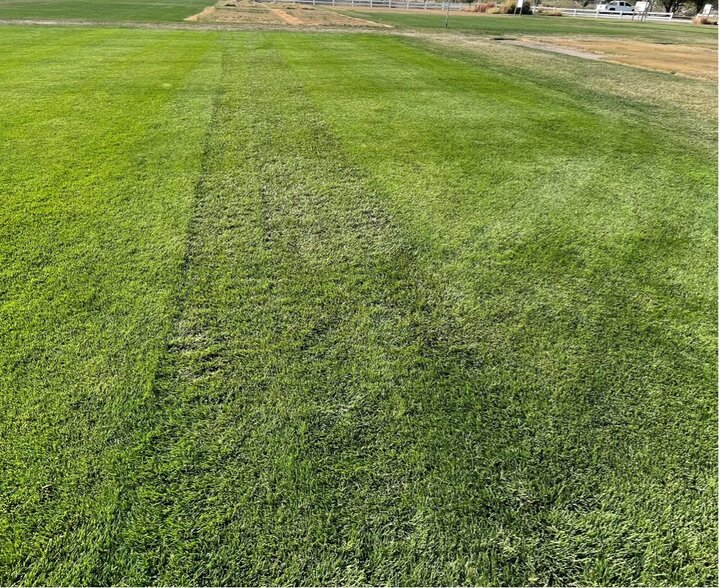
Two 17 ft x 8 ft plots were established to either HGT or 365ss Kentucky bluegrass in May 2023. The plots were divided by traffic treatment (traffic or no traffic). Traffic was simulated with a modified traffic simulator.
Progress
Current progress showed higher shear strength in no traffic for both KBG cultivars than in traffic areas for the 2024 and 2025 results. This is also similar in result of the NDVI. For the clegg (Gmax), It is higher with Gmax for traffic on HGT than in 365ss KBG traffic.