By Matt Sousek, Turf Research Manager
Presented at 2024 Nebaska Turfgrass Field Day
We all know that Yellow Nutsedge can become a huge problem if left untreated. With this research and previous research we have conducted on Yellow Nutsedge we are always looking for better ways to make the products we use more effective. It may be timing, rate, re-application, mowing, irrigation, temperature, surfactants, and many more that could possibly help us to achieve better control.
With this study shown at field day, we wanted to compare application timings, single vs split application, along with some of the industry leaders compared to a new product called Arkon.
Arkon is a post-emergence product that controls sedges along with many broadleaf weeds. It can be used on both cool and warm season grasses and is listed for most sites where turf is grown including putting greens and home lawns.
For this study we decided on a May 15 (A) application with or without a split applied June 15 (B) and a June 15 (C) application with or without a split applied on July 15 (D). The products we used were Arkon, Sedgehammer and Celero. All rates listed below were based off label recommendations. A non-ionic surfactant was also included in all treatments at a rate of .25% V/V.
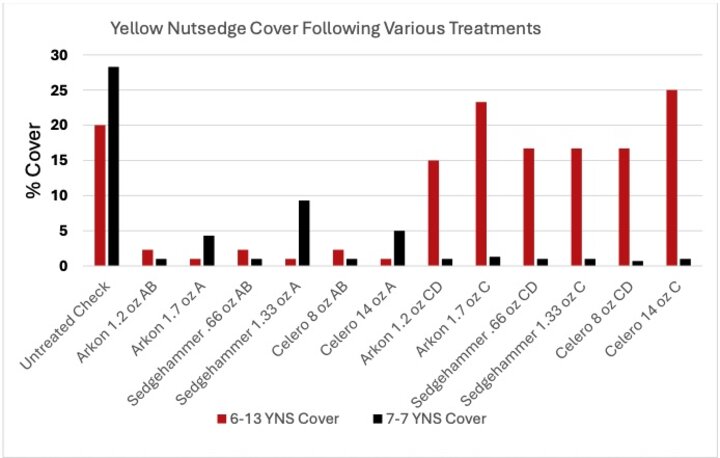
Preliminary results indicate that these products are doing a great job at reducing Yellow Nutsedge populations that we see. Looking at the first chart below, earlier applications rated on June 13th show that we did reduce Yellow Nutsedge to under 5% when we applied May 15 but at the next rating on July 7th it appears that single applications were resulting in near 5% populations of YNS. Looking at the C&D application timings all the treatments resulted in near 1% levels when rated on July 7th following the C treatment. Untreated plots ranged from 20-30% cover of Yellow Nutsedge to date.
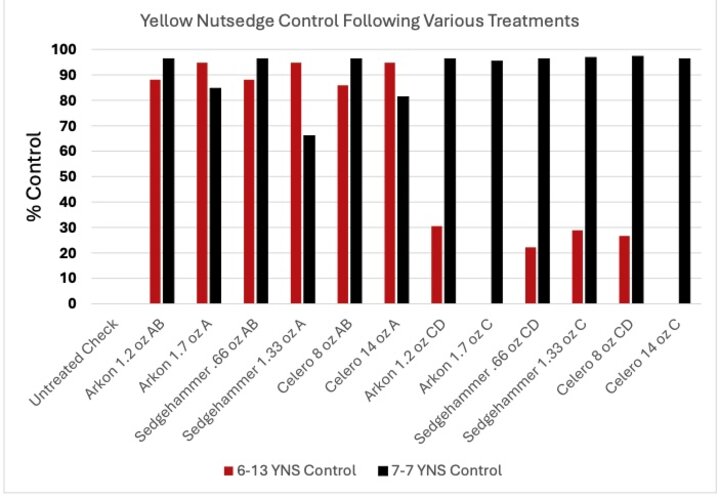
Looking at the results in a different view we can see the % control compared to the untreated plots. All treatments result in greater than 60% control when applied at the May 15 and or June 15 timing (A B). Since the June 15 and or July 15 timing (C D) has recently gone out it is too early to tell if season long control will be the case. Early ratings indicate near 100% control for the later June 15 applications. Since Yellow Nutsedge is emerging throughout the season it does go to show that the split applications have a better chance of reaching higher levels of control due to the additional active ingredient and potential for catching later emerged plants. This data shows the split applications are resulting in roughly 95% control compared to single applications at a range of 65-82%.
We hope that we can obtain some helpful information from this study as the season progresses and we will also rate next season to see if we controlled the tubers as well. As of now results are promising for the new product and its efficacy as compared to some of the best Yellow Nutsedge products.